Su Xiaobai's Alchemical Universe
Su Xiaobai (b. 1949, Wuhan, China) transforms the ancient medium of lacquer into a radiant, sculptural language. Trained at the Central Academy of Fine Arts in Beijing and the Kunstakademie Düsseldorf, Su bridges Chinese literati traditions and postwar European painting, having shifted from Socialist Realist figuration to a material practice between painting and object. A pivotal six-month stay in China's Fujian Province in 2003 led him to abandon oil paint for lacquer sap drawn from the Toxicodendron vernicifluum tree – used in China for millennia on both ritual objects and daily wares.

Su Xiaobai in front of Silence《寂静无声》, 2024, 198 x 191 x 16 cm, Oil, lacquer, linen, emulsion, wood
Courtesy Su Xiaobai Foundation. Photo © Marco Cappelletti / Marco Cappelletti Studio
Initially working on old burlap sacks, bamboo mats, and antique ceramic tiles from demolished Qing dynasty houses, Su reimagined lacquer not as coating but as substance. With the precision of an alchemist, he hand-grinds pigments and mixes mineral powders and shell dust into his "soup." With up to twenty layers applied on finely crafted wood supports, his lacquer surfaces sink and rise, interpenetrating each other as the multiple layers dry, hiding and revealing myriad chromatic depths.
An official Collateral Event of Biennale Arte 2026, Su Xiaobai's Alchemical Universe is presented by the Su Xiaobai Foundation in collaboration with the Los Angeles County Museum of Art (LACMA). Curated by Stephen Little, Curator of Chinese Art and Head of the Chinese, Korean, and South and Southeast Asian Departments at LACMA, and designed by architect Kulapat Yantrasast (WHY Architecture), the exhibition offers an unprecedented survey of Su Xiaobai's work in the lacquer medium.

Installation view: Su Xiaobai's Alchemical Universe, Room A.
Palazzo Soranzo Van Axel Venice (9 May – 22 November 2026).
Courtesy Su Xiaobai Foundation. Photo © Marco Cappelletti / Marco Cappelletti Studio
ABOUT THE SU XIAOBAI FOUNDATION
Su Xiaobai Foundation was founded in 2024 to preserve, promote and interpret Su Xiaobai's art and archives, and to support initiatives with a focus on his vision and craft. The Foundation seeks to support artists and scholars who share Su Xiaobai's commitment to reviving traditional materials and techniques in the production of contemporary art, through exhibitions, research and international dialogue.
In 2026, the Foundation launched a Curatorial Residency in Shanghai in collaboration with the University of Southern California's Roski School of Art and Design, providing annual funding for selected residency candidates to pursue new research. Among the Foundation's future activities is support for a symposium in the US on contemporary artists repurposing traditional materials.

Installation view: Su Xiaobai's Alchemical Universe, Room E.
Palazzo Soranzo Van Axel Venice (9 May – 22 November 2026).
Courtesy Su Xiaobai Foundation. Photo © Marco Cappelletti / Marco Cappelletti Studio

Installation view: Su Xiaobai's Alchemical Universe, Room G.
Palazzo Soranzo Van Axel Venice (9 May – 22 November 2026).
Courtesy Su Xiaobai Foundation. Photo © Marco Cappelletti / Marco Cappelletti Studio
ABOUT LACMA
LACMA is the largest art museum in the western United States, with a collection of more than 150,000 objects that illuminate 6,000 years of artistic expression across the globe. Committed to showcasing a multitude of art histories, LACMA exhibits and interprets works of art from new and unexpected points of view that are informed by the region’s rich cultural heritage and diverse population. LACMA’s spirit of experimentation is reflected in its work with artists, technologists, and thought leaders as well as in its regional, national, and global partnerships to share collections and programs, create pioneering initiatives, and engage new audiences.

Installation view: Su Xiaobai's Alchemical Universe, Room F.
Palazzo Soranzo Van Axel Venice (9 May – 22 November 2026).
Courtesy Su Xiaobai Foundation. Photo © Marco Cappelletti / Marco Cappelletti Studio
Excerpt from “Interview with Su Xiaobai” in Su Xiaobai’s Alchemical Universe (2026)
Stephen Little (SL) and Su Xiaobai (SXB)
SXB: In 2003 I was invited by the Minister of Culture of the German state of Rhineland-Palatinate in Mainz, which has a formal sister-state relationship with Fujian province, to investigate the possibility of creating a scholarly exchange program between Rhineland-Palatinate and Fujian, and to identify an institution of higher learning in Fujian that could provide a platform for such an exchange. Part of the curriculum for this exchange would be a program of teaching German to Chinese students and faculty, in order to facilitate the scholarly exchanges. As a result, I spent six months in Fujian in 2003 – not an easy half-year, and with relatively little funding. Despite this, I was according a warm welcome, in large measure because I represented a significant source of funding from abroad for the program – from Germany. In addition, by that time I spoke German with ease, and was perceived in Fujian as an emissary from Europe who also brought news of the goings-on of such internationally known artists as Josef Beuys, Gerhard Richter, and others, about whom relatively little was known at the time in China. During that half-year in Fujian, I spent most of the time meeting with different educational institutions, but in my free time I was meeting with local Chinese artists. In particular I became good friends with several lacquer artists, and in this way, I discovered lacquer as a new medium. For me, lacquer was entirely new, and it opened the door to new possibilities of surface and texture – possibilities that were not possible with oil paints. Furthermore, an added benefit of my move from oil to lacquer was that I was completely immune to the urushiol toxin in the lacquer sap, which usually causes severe rashes on the skin.
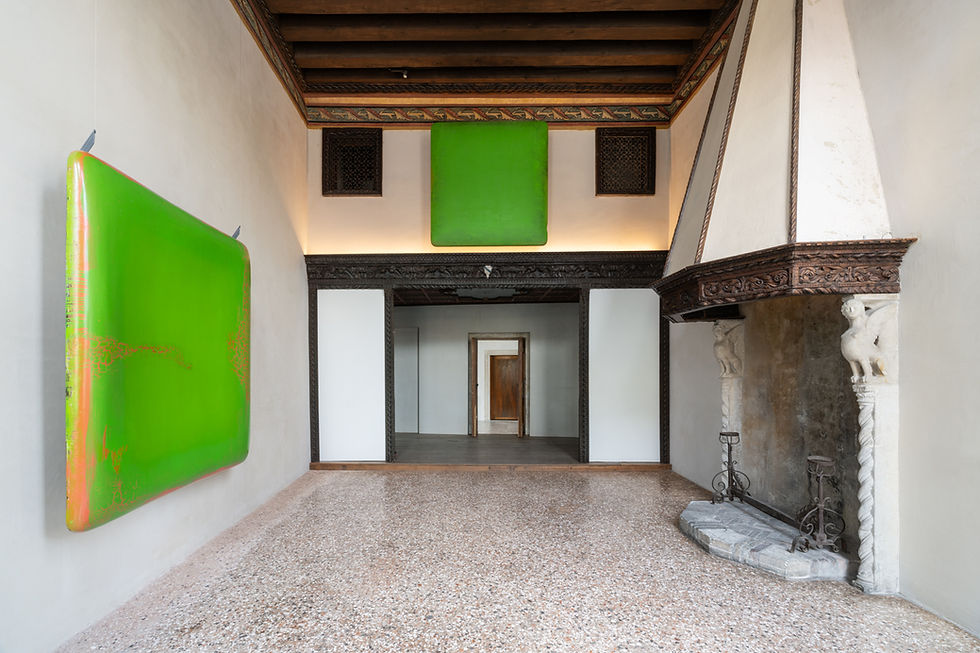
Installation view: Su Xiaobai's Alchemical Universe, Room B
Palazzo Soranzo Van Axel Venice (9 May – 22 November 2026).
Courtesy Su Xiaobai Foundation. Photo © Marco Cappelletti / Marco Cappelletti Studio
Fujian was famous as a center of lacquer production since the Song dynasty (960–1279). Even though the quality of the lacquer works made in Fujian is very good due to the coastal province’s low elevation and high humidity, Fujian is not necessarily an ideal climate for growing lacquer trees, and the quality of the lacquer is not as good as the lacquer produced elsewhere. Much of the lacquer resin (sap) used by artists in Fujian actually comes from other parts of China, particularly the provinces of Sichuan and Guizhou – this was also true in the Song and Yuan dynasties. Fujian certainly has lacquer trees, but the diameter of the lacquer tree trunks in Fujian is around four inches, whereas the diameter of the lacquer tree trunks in Sichuan is, on average, six inches. Working with lacquer is directly affected by the ambient humidity, which affects how fast or slow lacquer dries. This can result in it taking anywhere from fifteen days to fifteen minutes to dry. When I first begin working with lacquer in Fujian in 2003, I was applying the lacquer to a burlap ground glued to wood. The wood was elm (yumu), and it came from old wooden houses in Fujian that were being torn down, and the wooden boards on which I worked were put together with Ming dynasty-styled joinery. Sometimes I would use up to fifteen separate layers of lacquer on these works. The lacquer artists whom I met in Fujian were producing utilitarian household goods (qiwu) in factories; I became good friends with many of them. During the six months that I was in Fujian, I carefully observed how they made lacquer, and this gave me the idea to make my own artworks in lacquer. Why should I merely use common materials like oil and acrylic paints? In Fujian in 2003 I created 108 works in lacquer, of different sizes. I then shipped all of these to Germany, and in 2005 these were shown in the exhibition, Lacquer: Su Xiaobai's New Epochat Galerie Beethovenstrasse in Düsseldorf, and most of these works were sold.

Installation view: Su Xiaobai's Alchemical Universe, Room D
Palazzo Soranzo Van Axel Venice (9 May – 22 November 2026).
Courtesy Su Xiaobai Foundation. Photo © Marco Cappelletti / Marco Cappelletti Studio
When I first went to the Düsseldorf Art Academy in Germany on a scholarship in 1987 I became friends with my German professors. I was almost forty years old at the time, and had been working in a Socialist Realist style of painting. Between 1988 and 2002 my oil and ink paintings had been included in several exhibitions, but my professors did not think that they were in any way extraordinary. My professors told me, “You should not paint like us, in oils, because you are from a different culture (China), where ink and paper are used.” Then, in 2005 when they saw the 108 works in lacquer that I had made in Fujian they said, “This is the right direction in which you should move – this is your path; this is your art!” They even made a film about these works. Prior to this most of my works were figural oil paintings and ink paintings, sometimes accompanied by calligraphy.
The first lacquer works that I created in Fujian in 2003 were painted on burlap; this was actually an ancient technique known as tuotai (often translated as “dry lacquer”). This technique was known as early as the Warring States Period (481–221 BCE), and involved soaking layers of cloth in lacquer, which would then be molded in different shapes as the lacquer dried. I would then attach the lacquered fabric to a wood support.
Why should I, as a contemporary artist, stick to oil or acrylic paints? For one thing, lacquer is less expensive than oil paint, and for another, I was (and am) completely immune to the lacquer toxin (urushiol). Now I use a less toxic form of lacquer – I modify the lacquer that I use, so that it’s even less toxic. In my paintings I want to use as much lacquer as possible, and so to ensure that it doesn’t dry out I cover the many containers in which I store lacquer with a special plastic wrap to keep it dry. In thirty years I will be gone, so I want to enjoy using the best lacquer I can obtain.

Installation view: Su Xiaobai's Alchemical Universe, Room C
Palazzo Soranzo Van Axel Venice (9 May – 22 November 2026).
Courtesy Su Xiaobai Foundation. Photo © Marco Cappelletti / Marco Cappelletti Studio
In Fujian I found a piece of concrete shaped like a container. I put it on the floor and added wet clay to its interior to form a well, and then built up the well around that. I made the concrete well to prevent any of the lacquer from leaking away. I then put an old burlap potato sack saturated with lacquer into it, and richly soaked it further with even more lacquer. I used a worn hemp fabric burlap and added more lacquer to it, poked into it, and nailed it onto wood to hold its shape. This exercise soaked up my thirty years of prior learning. Other people use lacquer to fix things – when other people observed me doing this, they initially were all upset, because I was using so much lacquer. They said to me, “Is our conception of one year’s work even less than your one small part of a year?” I had to confess – it was not because I did not respect the ancient material of lacquer, but because I felt that artists such as Marcel Duchamp, Josef Beuys, Robert Rauschenberg, and Willem de Kooning would have done the same thing. I thought, “Why can’t I do this - to use the material freely and as abundantly as needed?” I used plenty of material, soaked into the old, used potato sacks, more than enough – four layers maximum. I tried using new burlap sacks, but they weren’t as good in soaking up the lacquer. Old potato sacks were the best – they were softer than the new sacks, and had old holes, tears, and hand-stitched repairs, features that are all preserved in the finished works. It took half of a year to complete all one hundred eight works, using the same concrete well the whole time, and the same setup. I experimented, and tried to use lacquer on fabric used to wrap water pipes, and tried using lacquer on leather.
SL: Lacquer on leather is also a technique used during China’s Bronze Age to make the amazingly strong individual plates for soldiers’ body armor.
SXB: While in Fujian I also applied lacquer to used bamboo mats, and then arrived at using old, discarded ceramic roof tiles from late Qing dynasty houses in Fujian that were being demolished. I collected ten thousand old ceramic roof tiles on which I tried all of the old techniques. Critics saw these works and said, “These are neither useful nor decorative,” but I didn’t care – I was manipulating the lacquer to make these works in ways similar to de Kooning’s fierce brushwork. Beuys had used meat grease as a medium – I never met Beuys because he died before I could meet him. I cleaned up the old tiles and wrapped them with linen and then, with enormous energy, painted them with lacquer. They were mostly small, with a few larger works. I never wasted fresh red pigment for the small pieces, but would use the red pigment left over from larger works to paint the smaller tiles. Later I occasionally experimented with blue pigment as well.
After that half year in Fujian, everything about my art changed. I stopped doing the same old things I had been doing before. In the six months that I was in Fujian my use of color was very economical, so I could use the colored lacquer to paint without concern about the amount of material and the cost, since I was careful to conserve and use left-over lacquer as often as possible.
SL: Did the Fujian lacquer artists whom you met think that you were crazy?
SXB: Contrary to what one might expect, the Fujian artists watching me work did not think I was crazy. Instead, they had a new kind of respect for me – in part because I was coming from Düsseldorf and had been sent as an official emissary on behalf of the Ministry of Culture of Rhineland-Palatinate, and because I was coming from the world of Gerhard Richter and Georg Baselitz, whose works the Fujian artists came to adore. So I came to Fujian with a halo, and the respect they gave me was automatic - this was so encouraging as I experimented with this new medium. At the same time, and significantly, the new respect they had for me was because they could see that I was taking risks.
Notes on individual group of paintings on the Piano Nobile:
A1–A7
The seven large paintings in the Piano Nobile’s high-ceilinged central gallery were created over the last seven years, and fully demonstrate Su Xiaobai’s mastery of the lacquer medium. Each of these works comprise many layers of lacquer.
Chasing Black-2 (A6) is a 2020 work in which the artist lays out, with tools of his own making, a grid of deeply scored horizontal and vertical lines into the paintings’ underlying surfaces. Over these he adds new layers of lacquer to build the painting’s upper surfaces. At first glance the work’s surface looks simple and monochromatic, but when seen close up the multiple effects of the scored lines in the lower surfaces and the superimposed liquid layers above create unexpected results – a seductive mix of violence, precision, and luxury. The painting, while clearly finished, appears on close examination to be alive and still evolving. Similar effects can be seen in two paintings from the following year: Refreshed–New-2 (A2) and Refreshed–New-6 (A3). In both works the physical and visual tensions between the paintings’ multiple layers create mesmerizing effects.
The largest painting in the exhibition is Stern-2 (A1, from 2023), where the artist’s intent was to create the illusion of space expanding outward in all directions. Its grid of scored lines was, as in other works, created with a graver, but the complexity of the underlying and overlying skeins of varied gray-green lacquer, some pale and some dark, some matte and some glossy, appear at points to break up the grid. The opaque areas of dark green lacquer open up windows in which space recedes into a seemingly immeasurable depth, against which the grid’s highlighted interstices appear like stars floating against an inchoate space.
B1–B3
The three paintings in this gallery reflect Su Xiaobai’s great love of green – his wife Zhang Jun explains, “Xiaobai is crazy about [the intense green colors of] Burmese feicui jade.” From 2013 comes the unusual work Fable (B1), its upper half painted with multiple layers of green lacquer with traces of underlying layers of red lacquer, and its lower half consisting of parallel horizontal striations gouged into the wooden base with a hand saw before being coated with uniform coats of black lacquer. In Generous Green (B2) and Luxuriant-Green (B3), one sees in the paintings’ wooden supports curved surfaces with beveled edges, inspired by the shapes of the hundreds of old discarded roof tiles that the artist collected in 2003 from demolished Qing dynasty houses in China’s Fujian Province. Speaking of these works, Su observed that he was seeking a form that was optically comfortable, in which there were no sharp edges, and one that was harmonious with the human body.
C1–C3
The works in this gallery reflect Su Xiaobai’s fascination with certain pigments of antiquity. For example, Tyrian Purple / Niao Niao-4(C2) refers to the city of Tyre in ancient Phoenicia (in modern Lebanon), one of the sources of the rare and expensive purple pigment made from the glands of murex sea snails in the shallow coastal waters of the Mediterranean Sea. This painting is also a significant example of the artist‘s use of powdered metals, visible in the horizontal bands of crushed iron filings suspended in lacquer scumbled across the surface. Through Su’s efforts to recreate ancient pigments he has become an archaeologist of lost Colors: Ever since I began painting with lacquer, the colors in my work seemed to come from nowhere. Even I could not explain them, nor did I wish to. I was not using color to tell a story; rather, I wanted colors that already carried their own stories. I searched for such colors. I bought a three-roll mill for grinding pigments, which my two assistants operated. My studio began producing its own paints, mainly a mixture of lacquer and pigments, but with experimental additions: carbon fiber, metallic powders, clam shell powder, and – unbelievably – lichen powder and cochineal powder - the latter derived from the small Dactylopius coccus insect that inhabits various forms of cacti, from which a strong red dye was extracted by both the Mayans and the Aztecs. For a single painting, I even went searching for the long-lost Tyrian purple, once extracted from the glands of sea snails on the Mediterranean coast two thousand years ago. The ancient harbor that produced it has long since fallen into ruin, now just a fishing village with nets hung out to dry.
D1–D2
Among Su Xiaobai’s most recent body of works is the introspective, elegant series of paintings entitled Niao Niao. The majority of works in this series are characterized by works painted in a wide range of monochromatic hues, from black to gray to thin silvery washes. The Niao Niao series is represented here by Floating Sand-4 (D1), and an installation of smaller works from the same series (D2). Niao Niao appears in the line Yu yin niao niao (余音袅袅) in the Former Ode to the Red Cliff composed by the 11th century poet Su Dongpo, in which the phrase refers to the lingering sound of a flute played by the poet’s friend. In time the expression Niao Niao came to embody a wide range of elusive associations, some verbal and some non-verbal. In Su Xiaobai’s words, Niao Niao conveys a wide range of sensations of things that are ephemeral and evanescent, like the ghostly radiance of the moon on snow, or footsteps in the snow, or the sound of a temple bell slowly fading into silence, or the quiet sounds of the Chinese vertical flute (xiao 箫), or something elegant and slow-moving, a woman’s gesture, or like smoke, or things that draw the least attention, or tender and gentle actions that convey love, or things that almost not there.
E1–E4
This gallery includes several of the artist’s most recent lacquer paintings – Admire (E1), Treasure (E3), and Van Axel Blue (E4), all completed in 2025. Here Su Xiaobai has achieved effects that could only have been created with lacquer. In Admire and Van Axel Blue the upper lacquer surfaces have been washed with water, with gentle pressure, while multiple layers of wet lacquer were still moving as they slowly dried beneath the surface. Admire recalls the “ice-crack” glazes of ancient Chinese ceramics, while Van Axel Blue, inspired by the light on the incandescent waters of Venice’s Grand Canal, simultaneously reflects the sky like a mirror and, like a lens, opens up the translucent realm below the waves.
F1
The one painting in this room – Clouds of Dawn–Song (F1, 2022), is a diptych. As in the earlier works Chasing Black-2 (A6), Refreshed–New-2 (A2), and Refreshed–New-6 (A3), the diptych’s panels are unified by a linear grid scratched into the lacquer layers beneath the upper surface. From a distance the work appears subdued, but the painting is deceptive, for at close range the multiple surfaces boil like a cauldron of highly charged particles. The painting’s mastery lies in its seemingly restrained turbulence.
G1–G3
One of the three works presented in this gallery is A Piece of Lacquered Burlap (G2), Su Xiaobai’s first lacquer painting. Created in Fujian province in 2003, it is painted in black and red lacquer on thickly woven sackcloth. The tears in the painting’s surface highlight the contrast between the upper layers of shiny lacquer and the underlying rough, matte fabric ground. One can see here the first appearance of a theme that runs through all of Xiaobai’s work in the lacquer medium: the significance in life of things that are either partially or fully hidden. A second early work from Su’s time in Fujian province in 2003 is the painting, Capital; II (G3), which appropriates the form of an ancient Han dynasty silk funerary banner. Into the upper rectangle of this archaeologically-inspired work the artist incised six vertical columns of an imaginary cursive script, reflecting his love of the beauty and complexity of ancient Chinese Calligraphy.
King’s Landing (G1), painted in 2009, consists of six large wooden panels joined to create a large screen. Large sections of the work are covered with opaque layers of shiny black lacquer, but the remainder of the surface is covered with torn, stitched, repaired, and heavily abraded sections of old burlap potato sacks that proudly reveal their former utilitarian use. With the contrast of the two surfaces – smooth, polished lacquer versus rough, absorbent burlap, it is one of the artist’s most dramatic works.