
Gathering 2
“Moonlight Halo, Lunar Cycle”
Film Screening and Conversation, Curated by Jenny Lin
July 1, 2026
20:30 – 22:00
Palazzo Soranzo van Axel
This program, conceived in the context of Su Xiaobai’s Alchemical Universe, will showcase a series of film works created by artists as devices for contemplation, interweaving the cycles of the body, machines, and the universe.
The films will be presented by curatorial duo Francesco Urbano Ragazzi, who will enter into conversation with featured artists including Bottin (Venice-based musician and musicologist), Jennifer West (artist, University of Southern California professor, and 2026 Guggenheim Fellow), and Jon Cuyson (artist representing the Philippines in this year’s Venice Biennale).
RSVP to Contact@suxiaobai-foundation.org
The Public Program is curated by Jenny Lin, PhD, Associate Professor of Critical Studies and Director of the MA Program in Curatorial Practices and the Public Sphere at University of Southern California Roski School of Art and Design, and inaugural Su Xiaobai Foundation Curatorial Resident.
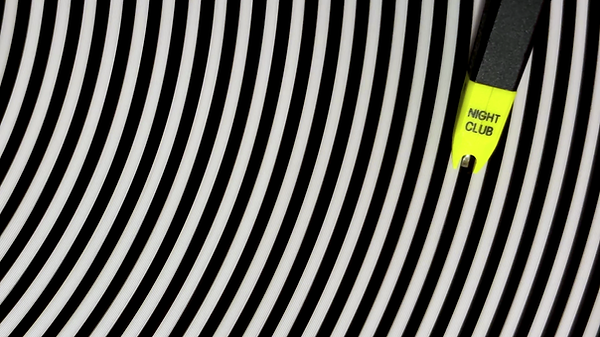
Marina Apollonio and Bottin, Endings: Nightclub (11 minutes, 22 seconds, 2025)
Endings: Nightclub is a collaborative work by artist Marina Apollonio (Trieste, 1940), whose exploration of optical and kinetic art has been ongoing since the 1960s, and composer and sound artist Bottin (Guglielmo Bottin, Venice, 1977). Drawing inspiration from the hypnotic spiral movements that have long defined Apollonio’s practice — particularly her lacquered wood pieces, Fusione Circolare (2016) and Fusione Circolare Doppia (2019) — the video depicts a spinning vinyl record that embodies the dialogue between the two artists. The work captures the rhythmic expansion and contraction of black and white lines. Meanwhile, a fluorescent yellow turntable stylus, labelled Nightclub, traces the record groove from start to finish. As the record plays, Apollonio’s op-art is activated as a kinetic sculpture, its oscillations synchronizing with the music. Bottin's electromechanical composition pulsates eerily, like deconstructed techno music. It is entirely composed of locked grooves. Bottin explains: “The only sound you normally hear in the end groove is the crackling of the stylus on dust and scratches or the faint echo of the final track. Several audio clips of identical duration—1.33 seconds, the time it takes for the 12-inch disc to make one full rotation—were recorded from different records. Without adding any other sounds, these fragments of ‘media noise’ were filtered and composed as tesserae in a polyrhythmic mosaic — a layered arrangement of accumulations, subtractions, and sudden interruptions.” Visual and auditory perception converge here in a sonic-kinetic artwork where music gives way to silence.
Jon Cuyson, Wet Dreams (9 minutes, 24 seconds, 2024)
Wet Dreams is a silent experimental film composed of fragmented, atmospheric sequences that move between abstraction and figuration. It constructs a porous visual field where bodies, water, and images dissolve into one another, resisting fixed narrative and stable identity. Working with original and archival materials, the film unfolds through gestures, textures, and durations that trace states of desire, displacement, and intimacy. Images emerge, repeat, and recede, forming a rhythm of drift and accumulation. At moments, fragments of maritime histories and contemporary tensions surface, only to dissolve back into a shifting, unstable field. Rather than following a linear structure, the work operates through sequencing and perception. The film becomes a sensorial environment where interior and exterior, body and landscape, remain in flux.
Jennifer West, Stitched Cosmos Animations (thousands of glass astronomical negatives, JWST satellite astronomical images, glass shards, notebook drawings, tools and aperture cards transferred to 6k, musical score by Japanese band, Open Reel Ensemble) (5 minutes, 40 seconds, 2026)
Stitched Cosmos Animations (scans hand-transferred to 6k, sound) comprises thousands of still images Jennifer West photographed on site at the Harvard-Smithsonian Center for Astrophysics, including glass astronomical negatives, scientific notations and drawings made by the Harvard Astronomical Computers, aperture cards, and fragments of damaged plates. By re-photographing and filming their surfaces, she translates these time-worn images into a moving image work, reactivating them and dispersing their latent energy into a kaleidoscopic field of proliferating fragments. Linking the work and discoveries of the Harvard Astronomical Computers to contemporary images produced by the James Webb Space Telescope, the film brings together more than a century of astronomical observation while reflecting on the transition from analog to digital image production. Accompanied by an original musical score by the Japanese band Open Reel Ensemble, West reanimates these archival materials and pays tribute to forms of female labor that have long gone unrecognized within science and across other domains of human culture. West created this piece in conjunction with her exhibition, Stitched Cosmos (Ca’ Foscari University, Venice, May-July 20206), curated by Francesco Urbano Ragazzi. She conducted related research with the support of a 2025-2026 Smithsonian Artist Research Fellowship and University of Southern California’s Advancing Scholarship in the Humanities and Social Sciences Research and Creative Project Grant.
Jennifer West, Selected Films (2008-2017):
Rainbow Party on 70mm Film (70mm film leader kissed with lipstick & impressed with teeth marks by Jwest, Mariah Csepanyi, Maggie Romano & Roxana Eslemiah) (39 seconds, 70mm, 2008)
Film transferred to digital video.
Lavender Mist Film/Pollock Film 1 (70mm film leader rubbed with Jimson Weed Trumpet flowers, spraypainted, dripped and splattered with nail polish, sprayed with lavender mist air freshener) (46 seconds, 70mm, 2009)
Film transferred to digital video. In LACMA/Yuz Collection.
I ♥ Neutrinos: You Cant See Them but They are Everywhere (70mm Film Frames of Neutrino Movements - shot in 15 ft Bubble Chamber at Fermilab, Experiment 564 in Chicago - dunked in liquid nitrogen, neutrino movements outlined with invisible ink and decoder markers and highlighters, inked up by Monica Kogler and Jwest, filmstrip from Janet Conrad, MIT Professor of Physics) (37 seconds, 2011)
Roll of specialized film for scientific use of 1,000 Images hand-transferred to high-definition digital video. Commissioned by MIT's List Visual Art Center, funded in part by the Nimoy Foundation.
Salt Crystals Spiral Jetty Dead Sea Five Year Film (70mm film negative floated in the Dead Sea and given a healing clay bath in extreme heat in 2008 - stuffed in a suitcase, placed in studio buckets, covered in clay and salt for five years - dragged along the salt encrusted rocks of the Spiral Jetty and thrown in the pink waters in 2013 in below 10 degree weather - Dead Sea floating and mud baths by Mark Titchner, Karen Russo and Jwest - Spiral Jetty dragging and rolling by Aaron Moulton, Ignacio Uriarte and Jwest - DIY telecine frame by frame of salt covered film by Chris Hanke) (54 seconds, 2013)
70mm film negative hand-transferred to high-definition digital video, remastered to 35mm optical print in 2024. In LACMA/Yuz Collection.
Pink Beach Red Desert Dream Sand Film (35mm film print featuring the dream sequence from Michelangelo Antonioni’s film, Red Desert, found on Russian Ebay - taken to the Pink Beach on Budelli Island off the coast of Sardinia, Italy where the film was shot in the early 1960s and dragged along the pink sand beach cove sand, rocks and bushes – sand covered film hand-transferred frame by frame) (3 minutes, 21 seconds, 2017)
35mm film print hand-transferred to high-definition digital video with sound. Commissioned in part by MAN Museo d’Arte Provincia di Nuoro, Sardinia, Italy.
Participants:
Francesco Urbano Ragazzi is a curatorial duo founded in Paris in 2008 by Francesco Ragazzi (PhD) and Francesco Urbano (PhD). Their practice reconnects art with reality through exhibitions that extend beyond galleries and museums, exploring a broader concept of public space. Their approach is exemplified by a trilogy of exhibitions curated in Venice on the occasion of the Biennale: “The Internet Saga” by Jonas Mekas (2015); “Hillary: The Hillary Clinton Emails” by Kenneth Goldsmith, with the participation of Hillary Rodham Clinton (2019); and “Adoration” byPauline Curnier Jardin and the inmates of the Giudecca detention house (2022). The duo has also developed projects for major institutions worldwide, including the MMCA (Seoul), School of Visual Arts, ISCP (New York), Kunstnernes Hus (Oslo), CERN (Geneva), Maraya Art Centre (Sharjah), Centro Ricerca Castello di Rivoli (Turin), Reykjavik International Film Festival, Centre d’Art Contemporain Genève, La Loge (Brussels), La Casa Encendida (Madrid), Institut Français (Paris), Ikon (Birmingham), Ruya Foundation (Baghdad). In the last five years, they co-edited FUORI!!! 1971–1974, an award-winning anthology dedicated to the first LGBTQ+ magazine in Italian history; they directed the 17th LIAF Biennial in Norway; and curated “Jonas Mekas 100!” in Italy, the international program celebrating the centenary of the legendary filmmaker, with whom they had long collaborated. In 2025, Francesco Urbano Ragazzi was named the first Italian curatorial fellow at the American Academy in Rome.
Jennifer West (b. Topanga, CA, 1966), a 2026 Guggenheim Fellow and a 2025-26 Smithsonian Artist Research Fellow is a Los Angeles–based artist whose work continues to challenge the distinctions between analog and digital image-making while tracing the cultural and material histories embedded within media itself. For over two decades, she has transformed 16mm, 35mm, and 70mm film into installations, sculptures, and participatory works that reimagine film as a living, communal medium. In 2026, West presented a solo exhibition, Stitched Cosmos concurrent with the Venice Biennial 61 at Ca’Foscari University in Venice, Italy. West’s projects have been commissioned by Tate Modern, the High Line, ICA London, Seattle Art Museum, LIAF Biennial Norway, Aspen Art Museum and Frieze Los Angeles, among others. In 2022, Radius Books published Jennifer West: Media Archaeology, launched at the Centre Pompidou in Paris on the occasion of Typofilm: Jennifer West. Her work has been presented in solo exhibitions at the Centre Pompidou, Times Square Arts, Yuz Museum in Shanghai, Seattle Art Museum, S1 Artspace in Sheffield (UK), Kunstverein Nürnberg (Germany), Contemporary Arts Museum Houston and St Louis, Joan Los Angeles, MAN Nuoro in Sardinia, Tramway Glasgow, White Columns in New York, and included in major group exhibitions at the Barbican in London, CAPC in Bordeaux, France, Kunsthalle Schirn in Frankfurt, ZKM in Karlsruhe, the Whitney Museum and the Drawing Center in New York. Her work is held in leading public collections including LACMA, the Hammer Museum, the Getty Museum, Kadist, MONA (Museum of Old and New Art), MOCA Los Angeles, the Thoma Collection, Rubell Collection, the Saatchi Collection and others.
Jon Cuyson is a Filipino interdisciplinary artist and filmmaker whose work explores maritime histories, queer ecologies, and the entanglements of labor, migration, and memory. Working across painting, installation, and moving image, he approaches the sea as a living archive where images, materials, and bodies circulate and accumulate over time. His paintings extend into spatial environments, functioning as both image and structure, while his films, including Wet Dreams, unfold through fragmented, atmospheric sequences shaped by desire, displacement, and oceanic imagination. A recurring figure in his work is Kerel, a queer Filipino seafarer who moves across projects as a shifting point of orientation through time and geography. In 2026, Cuyson represented the Philippines at the 61st Venice Biennale with Sea of Love / Dagat ng Pag-Ibig, an installation that brought together painting and film within a navigable horizon shaped by movement and relation.
Marina Apollonio (Trieste, 1940) is a central figure in the development of kinetic and optical art, with a prolific output that since the 1960s has blurred the boundaries between drawing, painting, sculpture, and installation. From the mid-1960s, she has been an integral part of the historical movements of Optical-Kinetic Art, gravitating around the Gruppo N in Padua and the Gruppo T in Milan, sharing both their research objectives and material choices. The artist’s rigorous plastic and geometric research focuses on the perception of circular movements, giving rise to captivating cosmic visions. Her work has been exhibited and collected by numerous international museums, including the Galleria Nazionale d’Arte Moderna e Contemporanea in Rome, MART in Rovereto, Neue Galerie in Graz, Kunsthalle Recklinghausen, Ritter Museum in Waldenbuch, Museum Haus Konstruktiv in Zurich, New Museum NYC, MAC in Lima, MACBA in Buenos Aires Kunsthal in Rotterdam, Kunstmuseum in Stuttgart, Tate Modern in London. She participated in the Venice Biennale in 1967 and 2022. In 2024, the Peggy Guggenheim Collection in Venice dedicated a major museum retrospective to Marina Apollonio, titled Beyond the Circle.


Bottin (Guglielmo Bottin, Venice 1977) is composer, sound artist and musicologist. After completing studies in psychology at the University of Padua, Bottin pursued a career as a musician and DJ in Italy and internationally. He has produced over 50 discographic releases for European and U.S. labels. In 2017 he presented a live electronics performance at the International Festival of Contemporary Music of the Venice Biennale. In 2019, he contributed to the creation of the Biennale’s Centro Informatico Musicale e Multimediale, organizing and coordinating popular electronic music workshops for the following three years. While pursuing a doctorate in musicology at the University of Milan, he was a visiting scholar at the Institut für Musikwissenschaft und Medienwissenschaft of Humboldt University, Berlin, where he conducted theoretical, historical, and anthropological research on technological approaches to groove and mechanical rhythm. Bottin has also contributed to contemporary art projects, organizing the sound design of Antoni Muntadas’ exhibition at the Spanish Pavilion for the 51st Venice Art Biennale and collaborating extensively with performance artist Chiara Fumai.
RSVP to Contact@suxiaobai-foundation.org